Understanding the Benefits of Thoracoscopy in Lung Treatments
In today’s medical world, thoracoscopy is essential. It makes diagnosing and treating lung issues more convenient for specialists. The advantages of thoracoscopy make it easier for those with lung diseases to get relief. Previously, thoracoscopy procedures were challenging. This blog delves further into the process of thoracoscopy. You’ll discover the procedure’s benefits for lung health care. The operation, advantages of thoracoscopy, and elements of patient recuperation are all covered in the blog. You will have a solid comprehension of this helpful treatment by the end.
Asthma Bhawan describes how this advanced, minimally invasive method has revolutionized contemporary respiratory care in its guide on the advantages of thoracoscopy in lung treatments. By utilizing a tiny camera to inspect the lungs and chest cavity through tiny incisions, thoracoscopy enables medical professionals to diagnose and treat lung illnesses, such as infections, tumors, pleural diseases, and unexplained breathing problems more accurately.
Introduction to Thoracoscopy
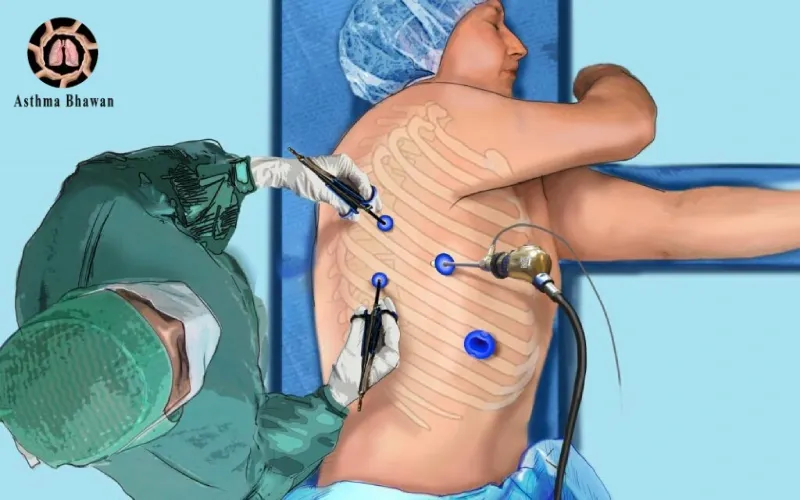
Thoracoscopy, also known as Video-Assisted Thoracic Surgery (VATS), uses a camera to view the area of your chest. In order to observe your lungs on a screen and identify problems, they create a number of tiny slits to place in the camera. This approach is less stressful and safer than conventional procedures. Both physicians and patients can benefit from the ease of use and efficiency of minimally invasive thoracoscopy.
Over recent years, surgery has improved significantly due to technology. A significant advancement in medical procedures is minimally invasive thoracoscopy. It helps physicians operate more accurately, which speeds up and simplifies procedures. Patients benefit from shorter hospital stays and fewer cuts.
It is essential to understand the distinction between thoracoscopy and thoracotomy. The older method, thoracotomy, entails making longer incisions in the chest to reach the lungs. On the other hand, thoracoscopy is less painful and requires fewer incisions. As a result, patients experience fewer issues and a quicker recovery.
Conditions Addressed by Thoracoscopy
Doctors use thoracoscopy to diagnose many lung conditions safely. It makes conditions like pleurisy and pneumonia easier to diagnose. This approach helps identify the reasons behind unexplained chest pain. Special procedures utilize thoracoscopy for focused lung treatments effectively. When necessary, a lung lobe is removed using a thoracoscopy lobectomy. It effectively treats cancer and tumor situations. In the meantime, tiny lung lesions are removed using thoracoscopy wedge resection. Thoracoscopy uses biopsies to confidently identify significant diseases. Through close monitoring, it helps physicians safely diagnose cancer. This approach greatly contributes to successful therapies by enabling early detection.
Advantages of Thoracoscopy Over Traditional Methods
Thoracoscopy is less invasive than thoracotomy. Thoracoscopy uses biopsies to confidently identify significant diseases. Through close monitoring, it helps physicians safely diagnose cancer. This approach greatly contributes to successful therapies by enabling early detection. In thoracoscopy, we see smaller cuts compared to open surgery. There are several appealing advantages to minimally invasive thoracoscopy. Patients heal more quickly, experience less pain, and leave fewer scars.
Doctors observe that thoracoscopy reduces costs for both patients and hospitals. Reduced hospital stays result in lower medical costs. Compared to typical procedures, patients resume their regular activities more quickly. Many families find thoracoscopy to be an attractive alternative due to these financial advantages.
Innovations in Thoracoscopy: Robotic-Assisted Techniques
In the field of thoracoscopy treatments, robotic assistance is relatively new. Thoracoscopy with robotic assistance enables surgeons to carry out procedures with extreme accuracy. The robots improve vision and stabilize movements. The procedures are now a lot safer and more successful thanks to this innovation.
Surgeons have more control over their actions when they use robotic thoracoscopy. The technology helps with accurate surgical procedures by providing sharper visuals. Certain tasks are performed by robots, which lowers errors and improves patient care. These tools help achieve top results with improved outcomes for those involved.
Robotic technology has a significant positive impact on surgical success rates. Patient safety is increased by the high accuracy with which procedures are carried out. Robots guarantee quicker operations with fewer issues. Patients are satisfied as a result, and everyone’s recuperation or hospital stays are shortened.
Recovery and Post-Thoracoscopy Care
Recovery after a thoracoscopy is quicker than traditional surgery recovery. Typically, within a day or three, patients can leave the hospital. Within a week, you can often resume your regular activities back home. It’s crucial to pay close attention to your doctor’s instructions regarding your particular circumstances.
Helpful steps for a good recovery include:
- Pain Management: Use the medicines given to keep pain under control.
- Breathing Exercises: These aid in the restoration of normalcy to your lungs.
- Activity Levels: These aid in the restoration of normalcy to your lungs.
- Follow-up Appointments: Attend all of your healthcare provider’s meetings.
Thoracoscopy recovery usually proceeds well; however, problems like as bleeding or infections may occur. Compared to open operations, these issues are less common, which increases patient satisfaction. Many report reduced discomfort and quicker recovery, demonstrating the advantages of minimally invasive thoracoscopy.