COPD Explained: What It Is, When to Worry, and When to See a Doctor
A minimally invasive technique for diagnosing issues with your lungs or airways is bronchoscopy. A bronchoscope is used by medical professionals to examine your lungs and windpipe. Additionally, they can gather tissue samples for bronchoscope investigation using microscopic devices. Imagine having a bronchoscopy, which allows you to see within your lungs without getting any cuts. Doctors use a thin, flexible tube with a tiny camera on the end to observe what’s happening inside your lungs and airways in this easy and safe medical procedure. Whether it’s a long-lasting cough, breathing trouble, or a suspicious shadow on an X-ray, bronchoscopy helps find answers.
At Asthma Bhawan, a trusted hospital for breathing and lung-related diseases, we use advanced tools like bronchoscopy to find out what’s really causing your symptoms. Bronchoscopy enables us to examine your airways more closely if you have issues like severe asthma, a persistent cough, chest infections, or trouble breathing. This test looks for blockages, edema, or infections inside the lungs using a narrow tube equipped with a tiny camera. Asthma Bhawan gives you not just treatment, but answers and a clear path to better lung health.
What is Bronchoscopy?
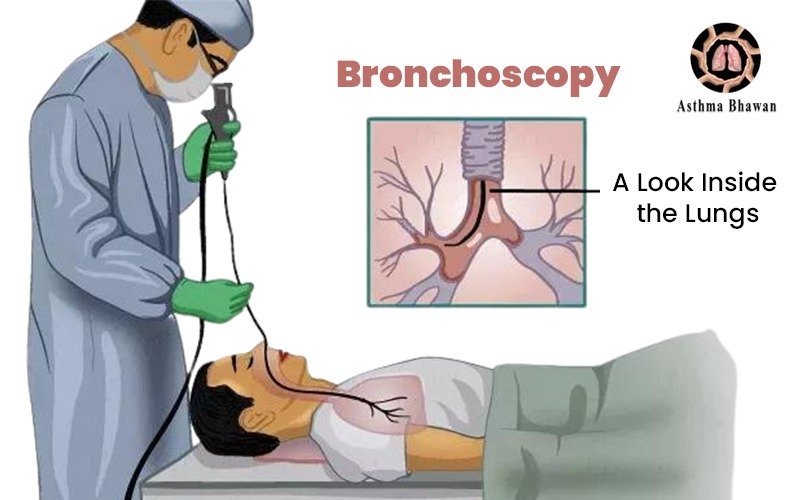
A bronchoscopy is a minimally invasive treatment that lets your doctor see inside your lungs and airways using a bronchoscope. A bronchoscope is a slender tube equipped with a camera and light. It can assist your healthcare professional in identifying, assessing, and occasionally treating disorders affecting your throat, trachea, or lungs.
Bronchoscopes can be either rigid or flexible:
- A bendable tube is called a flexible bronchoscope. Because it is easier to travel down your airway, providers utilize it more frequently. They use it to suction secretions, collect a tissue sample (biopsy), and maintain an open airway.
- A rigid bronchoscope is a firm tube. It is used by healthcare professionals when a big object becomes lodged in your airway or when more complex treatments are required, such as implanting stents or treating tumors or bleeding.
What Does a Bronchoscopy Diagnose?
To determine the cause of any lung issues you may be having, a medical professional could suggest a bronchoscopy. Some of the most common are:
- Following up on a CT (computed tomography) scan or X-ray that revealed potential cancerous findings.
- Evaluating and clearing obstructions or managing parts of your airways that have narrowed.
- identifying pulmonary conditions or other reasons for symptoms such as blood in the cough, dyspnea, or persistent coughing.
- Collecting tissue or mucous samples for laboratory analysis.
- Determining the underlying causes of infection or inflammation in the lungs.
- Putting in a stent, which is a tiny tube, to maintain your airway.
Test Details
How do I prepare for a bronchoscopy?
You will receive detailed instructions from your healthcare providers on how to get ready for a bronchoscopy. However, generally speaking, you will need to fast—that is, not eat or drink—for a specific period of time prior to the surgery. Additionally, you might need to stop taking blood thinners or diabetes drugs. Any vitamins, herbs, or drugs you use should be disclosed to your healthcare physician.
Do you need a CT scan before a bronchoscopy?
Your doctor would probably order a CT scan before a bronchoscopy unless there is an emergency. Your doctor can determine whether a bronchoscopy is necessary by using a CT scan of your lungs to assess lung diseases and conditions such as cancer or lung damage from cigarette smoking.
What Happens During a Bronchoscopy?
A bronchoscopy is usually performed as an outpatient operation by a pulmonologist in a hospital or surgical facility. This suggests that after the process, you can go back home. Usually, you are given some medication to make you comfortable and sleepy. Several biopsies and rigid bronchoscopies may require general anesthesia, or sleep. Your healthcare providers should be informed about the type of anesthesia that will be needed for your surgery.
These procedures are often followed during a bronchoscopy:
- A sedative is injected into your arm by your healthcare provider to aid in your relaxation.
- You prop your head up while lying on a table or bed.
- A numbing spray may be applied to your throat and mouth (or nose) by your healthcare provider. This lessens the pain you might experience when the bronchoscope is inserted.
- Your healthcare professional will numb the area and put you under sedation before inserting the bronchoscope through your mouth, nose, or a tube and down into the windpipe of your lungs while you are sedated.
- Since you won’t be able to swallow, your healthcare provider may use a suction device to remove saliva or spit.
- The bronchoscope is carefully removed by your provider after the procedure. The medical team keeps an eye on you until you’re completely conscious.
What Happens after a Bronchoscopy?
In most cases, the bronchoscopy is an outpatient procedure, so you won’t have to stay overnight. After the surgery, you can usually return home in a few hours.
Following the surgery, you will be observed by your healthcare team to make sure you are breathing and swallowing correctly. After the treatment, your doctor may want to order a chest X-ray to look for any indications of trouble.
For as long as an hour, you can have a thumb throat. You may experience coughing, sore throat, or hoarseness for the next 24 hours. This can be aided by using cough pills. Most people are able to resume their regular activities the next day. If you should limit your activities in any way, your healthcare provider will advise you.